The Lucas Museum of Narrative Art Opens: A Billion-Dollar Bet on Storytelling as a Curatorial Category
George Lucas and Mellody Hobson's billion-dollar museum opens in Los Angeles today, arguing that illustration, comics and cinema belong in the same rooms as painting and sculpture.
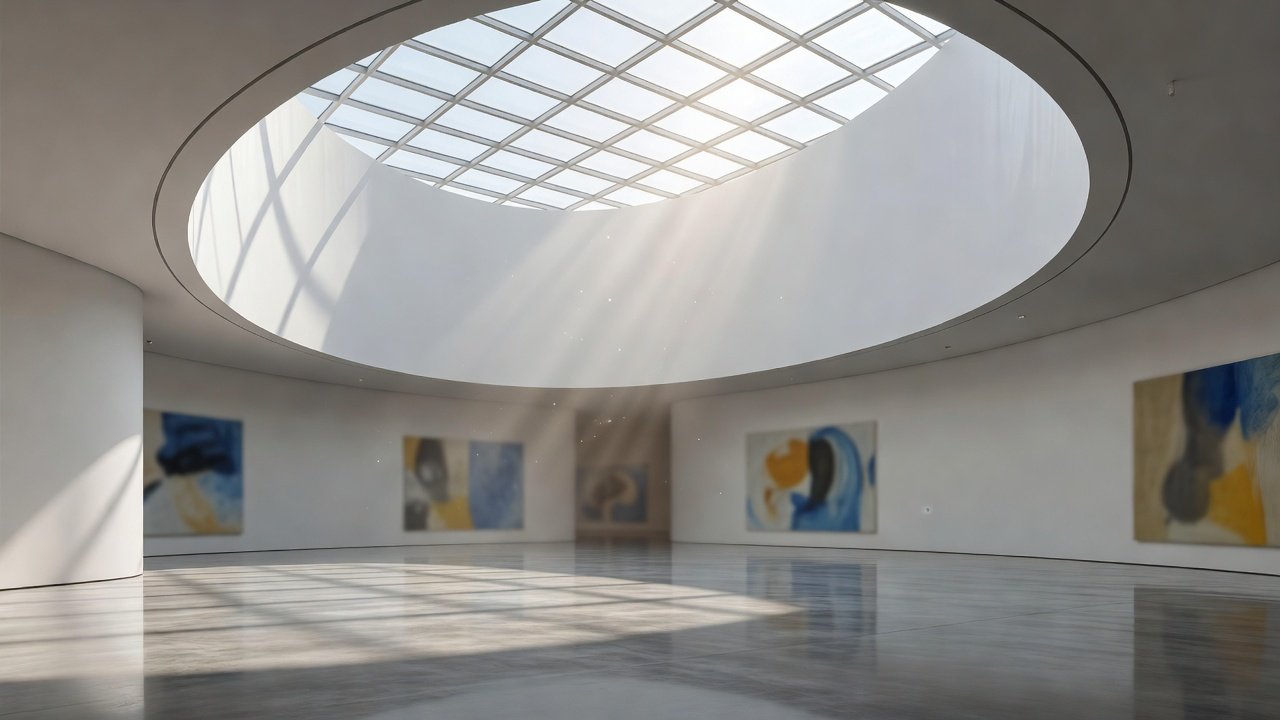
George Lucas and Mellody Hobson’s Lucas Museum of Narrative Art opens to the public today, 22 September 2026, in a 300,000-square-foot building in Los Angeles’s Exposition Park. It closes out a project that took sixteen years, failed to break ground in two other cities, and has cost Lucas something over a billion dollars of his own money — reporting varies between roughly one billion and one-and-a-half billion dollars depending on what is counted, on top of a stated endowment of at least $400 million. No public funding went into it. That fact alone is worth pausing on before getting to what is actually inside.
Sixteen years, three cities
The museum’s location is the least interesting fact about its history and the most interesting fact about its persistence. Lucas first proposed a museum for his personal collection of narrative and illustration art in San Francisco, where the project stalled; he then moved it to Chicago, where a years-long fight over lakefront zoning ended the same way. Los Angeles, which offered Exposition Park land near the University of Southern California and the city’s other museums, is where it finally landed, and where Ma Yansong of MAD Architects, working with Stantec, designed a building whose sculptural, cloud-like exterior is meant to be read as a landmark rather than a container. “I am deeply grateful,” Ma has said of the commission, “for giving me the opportunity to create a building that will faithfully serve the visitors and the art.” Whatever else the finished museum argues, the building itself argues that this was never going to be a quiet institution.
The argument the collection makes
The Lucas Museum’s founding premise is a curatorial claim disguised as a mission statement: that illustration, comics, photography, and cinema belong in the same conversation as painting and sculpture, not in a separate, lesser wing labeled popular culture. More than 1,300 works make that case across the inaugural program. The first floor holds The History of Narrative Art: Heroes, Myths, The Sacred, tracing visual storytelling across tens of thousands of years. The fourth and fifth floors organize thematic galleries around love, family, community, labor, sport, recreation, danger, and daring — categories chosen to cut across medium rather than respect it. Elsewhere, medium-specific rooms cover comic books, manga, graphic novels, photography, and murals, and artist-focused galleries are devoted to Norman Rockwell, N.C. Wyeth, Jessie Willcox Smith, Maxfield Parrish, Frank Frazetta, and Thomas Hart Benton — a roster that runs from magazine-cover illustration to American regionalism without treating the jump as a demotion.
“The artists in this collection didn’t just create images,” Lucas has said. “They connected our modern imaginations with our ancient emotions.” Hobson has framed the ambition in more populist terms: “We wanted a museum unlike any other — one that brings people from every walk of life through the same doors.” Both statements describe the same wager: that a museum built around narrative, rather than medium or period, will draw an audience that a conventional art museum’s usual categories exclude.
A wing built on purpose
The most obviously contentious piece of the inaugural program is a cinema gallery built around concept designs, props, and costumes from Lucas’s own films. It is an easy target for the objection that a wealthy filmmaker has built a museum with a wing for his own work, and the objection is not entirely unfair. But it is also the plainest illustration of the museum’s actual argument. If narrative art is a continuous tradition running from myth through illustration to cinema, a film’s concept art belongs in the same building as a Rockwell cover, on the same premise that a Rockwell cover belongs in the same building as a Renaissance narrative altarpiece. The gallery is either the museum’s clearest thesis statement or its most self-serving inclusion, and it can reasonably be read as both at once.
The case for scepticism, made fairly
The serious version of the critique circulating around the opening is not that Lucas built himself a shrine — plenty of major museums exist because one collector’s taste became a public collection — but that “narrative art” as a curatorial category is broad enough to justify almost any inclusion, which makes it harder to argue against than a category with real edges. A museum organized around theme rather than medium, period, or school gives its curators enormous latitude, and latitude that broad can flatten real distinctions: between an illustrator working to a commercial deadline and a painter working without one, between a film industry’s concept art and an artist’s independent vision. Critics have already begun asking whether the museum’s real innovation is curatorial or simply architectural and financial — a very large, very well-funded building organized around a premise elastic enough to include almost anything already in its founders’ collection.
That question will take years to answer honestly, and an opening date is the wrong moment to resolve it. What can be said now is narrower and more useful: more than a hundred thousand square feet of new gallery space just opened in Los Angeles, built without public money, organized around a genuine argument about how visual storytelling actually works across media — and the argument is worth testing room by room rather than deciding from the press release.
Sources: Lucas Museum of Narrative Art, “The Lucas Museum of Narrative Art Opens to the Public on September 22, 2026” · CNN, “Three cities, 16 years and $1 billion later, the Lucas Museum of Narrative Art opens” · ArchDaily, “First Look at the Completed Lucas Museum of Narrative Art”